Top Load Testing Tools: 50 Useful Tools for Load Testing Websites, Apps, and More
By: Alexandra
| April 7, 2017

As every developer knows, what works in the ideal scenario (a.k.a. your production environment) won’t necessarily work in the real world. That’s why you need tools like Retrace to help you quickly track down bugs and performance issues to keep things running smoothly.
Load testing, just one of many valuable testing methods you can use before release to ensure that your application is bug-free and runs seamlessly, is the process of testing whether an application can withstand the load of concurrent users, requests, and data volumes when in use. In other words, load testing is a must for determining if your applications can stand up to real-world use conditions.
There are many load testing tools available today for all kinds of applications and organization. In this article, we’ll look at 50 different load testing tools and highlight the key features of each of them.
Note: The following 50 load testing tools are not ranked or rated in any particular order of importance, but are listed in random order below.
@ApacheJMeter
Apache JMeter is a 100% pure Java, Open Source application that can be used to test performance on both static and dynamic resources, simulating heavy loads on individual servers, groups of servers, networks, or objects to test strength and analyze performance under different load types. Check out the getting started documentation here.
Key Features:
- JMeter is a Java application for load and performance testing
- Used to test web apps, SOAP & REST web services, FTP, databases, and more
- The most mature, and widely used open source load testing tool available
- Many commercial tools support JMeter
Cost: Open Source
@RadViewSoftware
WebLOAD from RadView powers the most demanding performance professionals in the world with enterprise-scale load testing.
Key Features:
- Lets you record actions and produces a test script in JavaScript
- Visually intuitive interface makes it easy to create and manage load testing scripts
- Enables performance testing for web, server-side, cloud, and mobile applications
- Well integrated with enterprise products from Oracle, SAP, Microsoft, and more
Cost:
- Free Edition available
- Contact for a quote
@SmartBear
A desktop tool for load, stress, and scalability testing for both websites and web apps, LoadComplete by SmartBear doesn’t require advanced coding skills – meaning you can focus on the more important tasks. Check out LoadComplete’s documentation here.
Key Features:
- Load testing for .NET and Java apps
- Generates various levels of traffic without requiring code inputs
- Test options available for IE, Chrome and Firefox
- Provides checks for both, secure and non-secure traffic
Cost: Plans start at $230 – $1,625 per month, based on a 1-year subscription
@Neotys
NeoLoad is an automated performance testing platform for enterprise organizations continuously testing applications and APIs. The platform provides testers and developers automatic test design and maintenance, realistic simulation of user behavior, fast root cause analysis and built-in integrations with the entire SDLC toolchain. NeoLoad lets you reuse and share test assets and results from functional testing tools to analytics and metrics from APM tools. It supports the full range of mobile, web and packaged applications, like SAP, to continuously schedule, manage and share test resources and results across the organization to ensure application performance. Check out the overview page here.
Key Features:
- Automated API Tests: Design, maintain and run performance tests as code and analyze results within continuous integration pipelines using pre-packaged plugins for CI/CD tools and the NeoLoad API.
- Code-less Test Design: Create test scripts quickly for large, complex applications using a graphical user interface and skip the complexity of hand coding new and updated tests.
- Dynamic Infrastructure: Easily set up testing resources as needed and automatically free up resources as tests complete. Use test infrastructure efficiently and improve TCO.
- Resource Reservation: Reserve load testing infrastructure (licenses, load generators, VUs) by date and duration and guarantee resources are available and dedicated.
Cost: Contact for a quote
@locustio
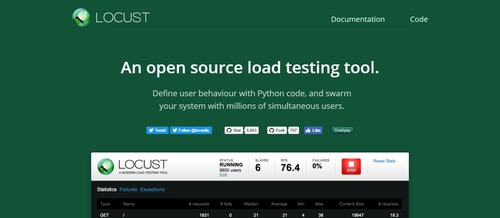
Locust is an Open Source load testing tool that enables you to define user behavior using Python to test your system’s performance under millions of simulated, simultaneous users. Full Locust documentation is available here.
Key Features:
- Allows you to write expressive scenarios in plain-old Python
- Enables testing on any system, and multiple systems at the same time
- Uses community members to add to the traffic
Cost: Free
@BlazeMeter
A performance engineering platform for DevOps, BlazeMeter enables you to run and analyze JMeter and other open-source load tests from anywhere.
Key Features:
- Quickly pinpoints defects using inbuilt error report function
- Detailed and interactive report timeline graph to make the report clearer
- Thorough testing using both, API backend and frontend
- Uses YAML and JSON syntax for developers using these languages
Cost:
- Free for 50 concurrent users, 10 tests, 1 shared load generator
- Plans start at $99 – $499 per month
7. Load Multiplier
@exec_hr
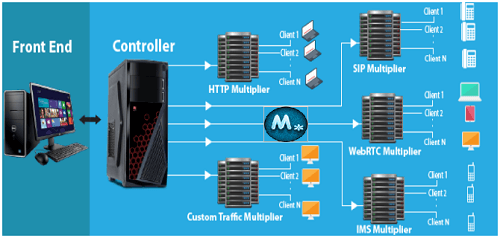
Load Multiplier is a testing framework to test IT products across domains such as telecommunication, banking, web, proprietary protocols. Additionally given a client library, it can generate millions of such client instances so as to generate real field traffic. It comes with a web based front end, and powerful C/C++ based back end engine.
Key Features:
It provides stable uninterrupted long hour load testing solution for products based on:
1. WebRTC
2. IoT
3. SIP, IMS
4. RTP, RTCP
5. STUN, TURN, ICE
6. HTTP, SOAP, REST
7. JSON, XML
8. G711u, G711a, AMR, OPUS, VP8
9. Any proprietary text / binary protocol
Cost: Contact for a quote
@onloadtesting
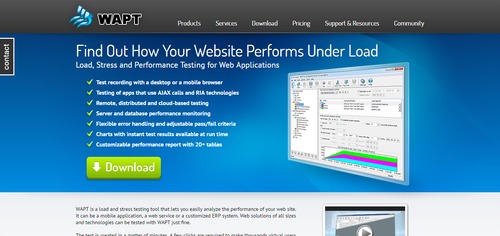
A load and stress testing tool for easily analyzing website performance, WAPT creates tests in minutes for mobile applications, web services or customized ERP systems. The full WAPT documentation is available here.
Key Features:
- Sends reports to mobile device and desktop device for convenience
- Provides extensions to work with ASP.net, Adobe Flash and Silverlight
- Test results are shown in 20 different detailed reports
- Provides detailed graphs even during the runtime, to help track the performance
Cost:
- WAPT: Starts at $700
- WAPT Pro: Starts at $1,200
@Telerik
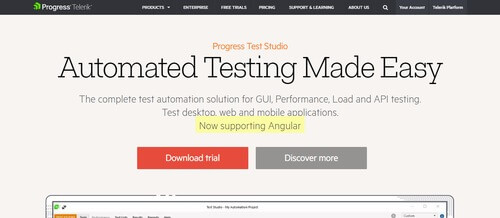
A complete test automation solution for GUI, performance, load, and API testing, Test Studio from Telerik is a useful tool for testing desktop, web, and mobile applications. The full documentation is available here.
Key Features:
- Provides testing for HTML5, AJAX, Android, WPF
- Allows users to share and pick references from Element Explorer
- Developers can use any language they are used to
- Users can test any NativeScript app over 500+ devices
Cost:
- DevCraft: $1,499/developer (perpetual license)
- Telerik Platform: Starts at $39 per month per developer
@loaderio
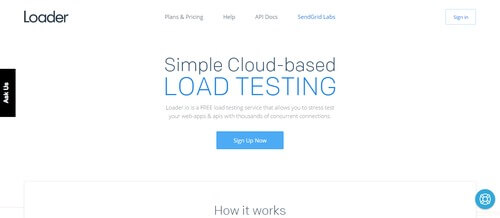
Loader.io offers simple cloud-based load testing for stress testing your web apps and APIs with thousands of concurrent connections. Check out the documentation here.
Key Features:
- Runs tests for you anytime and from anywhere
- Allows monitoring of the test and performance from any place
- Provides stress test result in descriptive graphs which will be sent to all users
Cost:
- Free: 10k clients/test
- Pro: $99.95 per month – 100,000 clients/test
11. HPE LoadRunner
@HPE_Loadrunner
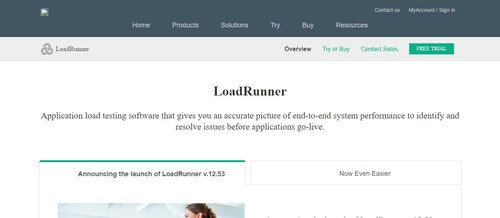
Get a complete picture of end-to-end system performance to identify and resolve issues before your apps are released with HPE LoadRunner.
Key Features:
- Reduces the time it takes to understand and explain the reports
- Supports wide range of applications to decrease time and skill
- Provides detailed mobile performance test reports
- Combines load testing with development tools like IDE, jUnit and more
Cost: Contact for a quote
12. StormRunner Load from HP
@HPE
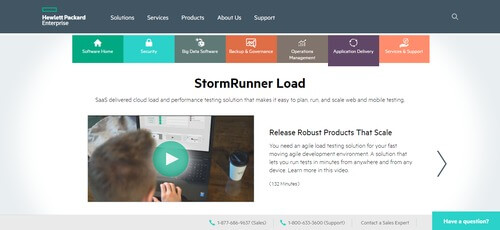
An SaaS-delivered cloud load and performance testing solution, StormRunner Load makes it simple to plan, run, and scale testing for both web and mobile apps.
Key Features:
- Takes 10 minutes to design and create web load or mobile test
- Tests can be managed from anywhere using a cloud based testing function
- Can quickly scale from 1 to 1,000,000 geographically distributed web and mobile user
Cost: Contact for a quote
13. CloudTest from Soasta
@SOASTAInc

CloudTest provides scalable and affordable load testing tools for more efficient, transparent performance testing.
Key Features:
- Gets real user experience from 95 different locations in all 7 continents
- Provides you with 40 cloud service providers to make your testing seamless
- CloudTest automation tools quickly and easily integrate with yours
- Importing existing JMeter test scripts have been made easy
Cost:
- Lite: Free for 100 virtual users
- On-Demand: Starts at $2,500
@philip_aston
A Java load testing framework, The Grinder makes running distributed tests simple using many load injector machines. The Grinder is maintained by Philip Aston, who took over the code (originally developed for the book Professional Java 2 Enterprise Edition with BEA WebLogic Server by Paco Gómez and Peter Zadrozny) and reworked it to create The Grinder 2 and subsequently The Grinder 3. The full documentation can be found here.
Key Features:
- Test scripts can be written in Clojure and Jython
- Any Java API can be loaded as a test, be it from HTTP web servers, SOAP and REST services, etc
- Pre-built Java libraries with large variety of systems and protocols is available
Cost: Free
An Open Source, multi-protocol, distributed load testing tool, Tsung helps you test the performance and scalability of IP-based client/server applications. Check out the full documentation here.
Key Features:
- Multiple IP addresses can be opened on one machine using their OS IP Aliasing
- Response time can be measured during the load by generating HTML reports
- HTTP, WebDAV, MySQL and LDAP servers can stressed using this software
Cost: Free
@GatlingTool

An Open Source load and performance testing tool for web applications, Gatling helps you improve time-to-market by identifying bottlenecks, errors, and performance issues prior to release. Gatling documentation is available here.
Key Features:
- Can forecast performance issues in the web application you make
- Errors and bottlenecks will be detected in the early part of the development cycle
- Drastically reduces the debugging phase time
- Provides the best digital experience to customers and users
Cost: Free
Because automating repetitive tasks just makes sense, Taurus provides an automation-friendly framework for continuous testing. You can read the full documentation here.
Key Features:
- Provides smooth automation and integration of JMeter and other systems
- Creating, running and analyzing performance tests are made simple
- Has a different approach and system than The Grinder and Gatling
- New tests can be made from scratch using control friendly and unified DSL
Cost: Free
Httperf is an Open Source HTTP load generator for measuring web server performance that facilitates the construction of both macro- and micro-level benchmarks.
Key Features:
- This is a simple open source tool for measuring web server performance
- It is solely made to test standard http payload of the application you test
- High performance and robust tool that helps create micro and macro benchmarks
- It is able to create and sustain server overloads
Cost: Free
@MicroFocus
Micro Focus Silk Performer understands that the biggest and most complicated issues happen at the most inconvenient times, so Silk Performer is designed to provide a consistent user experience anywhere, anytime, on any device. Check out the documentation here.
Key Features:
- Load tests reflect real world user behavior with their different constraints
- Provides unlimited cloud support for load testing on mobile devices and systems
- Prepares application for low bandwidth users
Cost: Contact for a quote
@TheASF
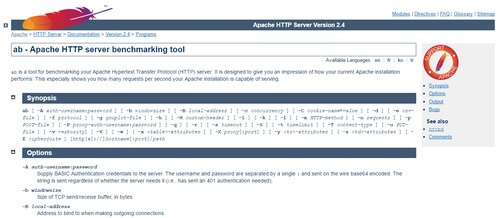
A tool designed for benchmarking an Apache Hypertext Transfer Protocol (HTTP) server, ApacheBench gives you an accurate picture of how your current Apache installation performs. The documentation is available here.
Key Features:
- Provides better support for asynchronous read and write
- Keepalivetimeout can be specified in a millisecond
- Helps you understand how your current Apache installation performs
Cost: Free
21. ZebraTester
@apicasystems
Offering powerful tools and flexible options, ZebraTester enables you to easily create and run tests of nearly unlimited scale with incredible visibility into your results.
Key Features:
- Includes performance testing for CI/CD process using LoadTest Portal
- Apica team helps design, execute and manage the project
- Security policies have been given equal importance, and subsidiary software is available
- Free 500VU are provided on their global network and LoadTest Portal
Cost: Contact for a quote
@Experitest
Experitest offers several testing tools for mobile apps, including a mobile add-on for HP LoadRunner, which makes it possible to perform mobile load testing by connecting real devices and testing your applications under simulated loads. Read the full documentation here.
Key Features:
- This is specially made to test your mobile applications load taking capacity
- Runs the same tests as systems on the mobile devices
- Create and edit mobile tests inside LoadRunner
- Creates report screenshots and videos of the application
Cost: Contact for a quote
@LoadImpact
With nothing to install and easy configuration, Load Impact offers instant load testing for devops and developers. Read the full documentation here.
Key Features:
- Connects you with performance trending analytics and notifies through webhook
- Provides a powerful Lua scripting environment to allow you to create simple or complex API scenarios
- Record results of test uploaded on website or app using their chrome extension
- They have provided more than two million customers with load testing service
Cost: $89 – $1,299 per month
24. AgileLoad
@AgileLoad
Optimize your load and performance testing costs with AgileLoad, which provides distributed and cloud-based testing on-demand and server and database monitoring in a single package.
Key Features:
- Helps you create complicated scenarios in minutes using their Web 2.0 technology
- Allows you to simulate your load from any location, through the Cloud
- Gives you an accurate end to end picture of your application’s performance
- Lets you correlate different load test by combining them in one graph
Cost:
- Starts at $192 per month
- Daily rental starting at $24 per day
@LoadStorm

An easy and cost-effective way to load test both web and mobile apps, LoadStorm helps you find the breaking point of your applications and other weaknesses before your customers do.
Key Features:
- Provide full project management, where they do all the test work for you
- Cloud servers are able to run load tests up to 1,000,000 VUsers
- Allows logins from any location around the world
- Provides control of spreading the traffic to any geographic location
Cost: Contact for a quote
26. Visual Studio Team Services
@VSTeam
Visual Studio Team Services offers cloud-based load testing to performance test your code under the weight of thousands of users.
Key Features:
- Uses Azure to make Cloud-based load testing easy and quick
- Visual Studio Team Service can help make tests by your references of other websites
- Correlates test results with server diagnostics
- Functions to record and replay your actions are also available
Cost:
- Free up to 5 users
- Growing Teams: Starts at $30/month for 10 users
@loadsterperf
A full-featured testing solution for websites, web apps, and web services, Loadster is built for real web applications and can handle cookies, user sessions, custom headers, and more with ease.
Key Features:
- Gives a hybrid solution for load testing with ground server and cloud system
- Provides two options for generating concurrent user, from their server and your own
- Concurrent users are generated from 5 different continents
- Loads multiple tests at once and generates users for all tests
Cost: $79 – $2,999
@dotcom_monitor

LoadView provides flexible load testing from the cloud for websites, web apps, mobile, and APIs. With a 100% managed cloud, there’s no need to set up your own third-party cloud accounts.
Key Features:
- Complete Cloud-based load testing software, eliminating hardware hassle
- Allows you to pay according to the use if you don’t want to pay for a month
- Shows you the load stress for real world browsers
- Trusted by Volvo, Dell and ComCast
Cost (per load test):
- Each Virtual Machine: $4
- HTTP Load: $0.01 per user per minute
- Full Browser Load: $0.10 per user per minute
- Flat monthly cost to store test result data: $9.99
@ShoreditchOps
A modern, powerful, and easy-to-use load testing toolkit, Artillery empowers developers to make scalable, performant, and resilient applications that can stand up to high load. The documentation is available here.
Key Features:
- Supports multiple protocols- HTTP(S), WEbSockets and Socket.io
- Software prefered by ecommerce backends, loT bankends and transactional APIs
- Supports Statsd, Datadog, InfluxDB and Librato
- Use npm modules and customize load tests with Java Script
Cost: Free
@testplant
Ensure that your cloud and server-based applications will continue to work, perform flawlessly, and provide a consistent user experience with eggPlant. Check out eggPlant’s documentation here.
Key Features:
- Technology support includes client-side .NET, client-side Java, Citrix and TCP/UDP
- Load test creating tools are easy, which helps new and experienced users design
- C# and Java are fully integrated to help faster script authoring
- Provides live monitoring to help control tests while they run
Cost: Contact for a quote
@applause
Offering a range of load testing services, Applause helps you ensure that your apps and websites can handle the biggest loads on your most successful days. Check out the documentation here.
Key Features:
- Pre-built custom load scripts to reduce scripting time and money
- Provide expert help to interpret load test results for better insights
- Give access to experts who craft custom Apache JMeter load testing scripts
- Provides cloud-based infrastructure for flexible scaling
Cost: Contact for a quote
@soapui
LoadUI provides load testing for REST and SOAP APIs to ensure your APIs never let you down. You can rapidly create API load tests either against a single web service endpoint or an existing functional API test.
Key Features:
- Allows reuse of existing SoapUI Pro functional tests
- Can run several load test scenarios continuously with one another
- See the interaction of each scenario and the impact they have
- Shows how your server reacts to traffic and diagnose the bottlenecks
Cost: $4,999 – $14,999 per year
JCrawler is an Open Source stress testing tool for web apps with a crawling/exploratory feature enabling you to define a set of starting URLs for JCrawler to begin crawling and generating loads. Check out the documentation here.
Key Features:
- Can be used through little bandwidth, doesn’t require high internet speeds
- Uses XML file to configure, which makes it easier to create load tests
- Can be run on any type of system
- JCrawler tools specially made for developers and QAs
Cost: Free
@StresStimulus
A load testing tool for both web and mobile applications, StresStimulus measures web performance and scalability under heavy traffic loads. The full StresStimulus documentation can be found here.
Key Features:
- Records traffic for mobile devices like Apple, Android, Windows and Blackberry
- Works smoothly with all main web platforms- Java, PHP and ASP.NET
- Supports many Enterprise applications CRM, SharePoint, Silverlight and more
- The only software that can be used as an add-on for
Cost: $1,040 – $3,950 per month (Perpetual 250 VUs License)
A distributed software testing architecture designed around CORBA, OpenSTA performs scripted HTTP and HTTPS heavy load tests with performance measurements from Win32 platforms. The documentation can be found here.
Key Features:
- Made for experienced and proficient testing users
- Records can be played by different users’ perspectives for better understanding
- Open Source tools licensed under GNU General Public License
- Was made to be free for user and will always remain free
Cost: Free
36. SOAtest from Parasoft
@Parasoft
With SOAtest from Parasoft, you can automate complete end-to-end testing for both business- and security-critical transactions.
Key Features:
- Provides a user-friendly interface for monitoring live application of traffic
- The tests are engineered to shared, reused and extension easily
- Includes static analysis, code review, code coverage analysis and runtime error detection
- Designed to make load testing without scripting possible
Cost: Contact for a quote
@APImetricStats

You can’t afford latency in your APIs, and APImetrics aims to solve that challenge by putting real-time API performance data at your fingertips.
Key Features:
- Provides real-time alerts and notifications covering failures, speed and size issues
- Daily, weekly, monthly and yearly review given through detailed reports
- Gives you functionality for every sector you service
- Allows you to measure the latency and uptime from any location or cloud
Cost: Starts at $10,000 per year
An AWS Lambda powered, distributed load testing tool, GOAD enables you to launch HTTP loads from up to four AWS regions simultaneously. Check out GOAD’s documentation here.
Key Features:
- Allows HTTP load launch from four different AWS at the same time
- A single lambda is able to handle hundreds of concurrent connections
- Peak load of up to 100,000 concurrent requests
Cost: Free
A library injection technique that employs the concept of reflective programming, Reflective DLL injection performs the loading of a library from memory into a host process. Check out the documentation on GitHub.
Key Features:
- This follows the concept where reflective programming is employed
- The library loads itself by using minimal portable execution
- It interacts with the minimal interaction with the host system
- Injection works on Windows NT$ and up including Windows 8
Cost: Free
@Loadtracer
A user-friendly tool for web application load testing and performance testing, LoadTracer works like many other load testing tools, recording scripts and playback with hundreds of virtual users.
Key Features:
- It helps with web application load testing, monitoring and performance testing
- Uses various techniques to record and find bottlenecks and latency issues
- Also provides tools for website loading tests
Cost: Contact for a quote
A free, Open Source web application tool, Solex was built as a plug-in for Eclipse IDE. The full documentation can be found at SourceForge.
Key Features:
- Provides functions to record client sessions and replay it later after adjusting
- It acts as a HTTP proxy and records HTTP requests between Web client and server
- It is an international Open source project, which makes it more helpful
- It is based on Eclipse platform, making tools fully integrated
Cost: Free
Bees with Machine Guns is a nifty little utility that sends swarms of “bees” to attack (a.k.a. load test) your web applications. Check out the documentation here.
Key Features:
- Helps create micro EC2 instances called bees to load test web applications
- Uses Python 2.6 – 3.6, Boto, Paramiko dependencies
- Can be pointed at any web application to test the load taking capacities
Cost: Free
43. Appvance
@appvance

The first unified test automation platform that completely transforms the software QA process, Appvance eliminates silos and helps you see your app’s performance through your users’ eyes.
Key Features:
- Tests your applications and shows how a user would see it
- Finds bugs the user would find on their browsers and mobile applications
- Data-drive is available for any language you use
- Brings in a new level of smoothness in their record and play script creation
Cost: Starts at $99 – $1,200 per month
nGrinder is an enterprise-level performance testing solution based on The Grinder, allowing you to execute script creation, test execution, monitoring, and the result report generator simultaneously. Check out the documentation here.
Key Features:
- Uses Jython and Groovy to design scenarios and create stress in JVM
- Tests can be extended to limitless customs, using their unlimited library
- Library consists Jar, Python, Maven dependencies
- Allows you to monitor the agents creating stress and the targeted machines
Cost: Free
@IBM
Test earlier and more often with Rational Performance Tester, which validates web and web server applications for scalability, identifies bottlenecks, and more. Check out the documentation here.
Key Features:
- Allows early and frequent tests of DevOps approach
- It helps see the extent of the web and server scalability
- Identifies the presence and cause of the performance bottlenecks and system issues
- Provides root cause analysis feature to find and diagnose the issue
Cost: Contact for a quote
An Open Source Java-based framework that you can incorporate into your applications for performance testing, J-hawk generates performance reports to help you identify bottlenecks. Check out the documentation here.
Key Features:
- An Open Source Java based framework to test the performance of the application
- Uses its own scripting language called $hawk scripting
- Provides two ways to use j-Hawk- Property Mode, Script Mode
- j-Hawks solves what junits does not solve
Cost: Free
@SeleniumHQ
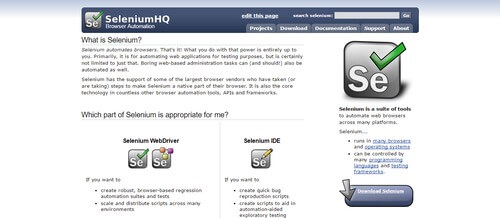
Selenium isn’t actually a load testing tool itself, although its powerful browser automation features enable various load testing scenarios for low-scale browser loads. Check out Selenium’s documentation here.
Key Features:
- Though not a load testing tool itself, its powerful browser automation features enable various load testing scenarios
- Provides two types of applications for user, based on the kind of work they want to execute
- Selenium WebDriver creates robust browser tests and automation suites
- Selenium IDE designs scripts to help Automation exploratory test
Cost: Free
Check out our Selenium tutorial!
48. Performance Center from HP
@HPE
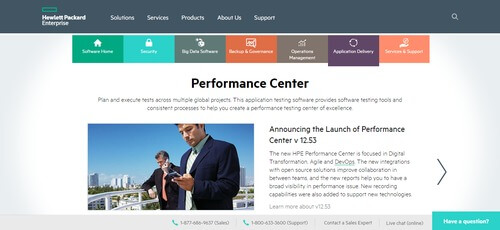
With Performance Center from HP, you can plan and execute tests across multiple global projects. With software testing tools and consistent processes, you can create a world-class testing center with ease.
Key Features:
- Is updated to be compatible to all sorts of hardware
- Creates a common testing infrastructure for engineers located around the globe
- Use tests stored in the Cloud or in your premise behind a firewall
- Reduces cost by creating a shared tests report infrastructure for engineers
Cost: Contact for a quote
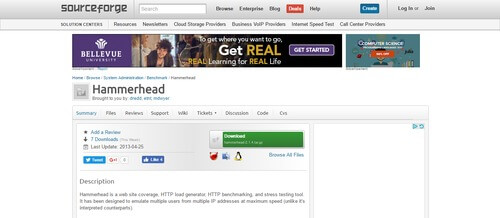
A web site coverage, HTTP load generator, HTTP benchmarking, and stress testing tool, Hammerhead is designed to emulate several users from different IP addresses at maximum speeds to push your apps to the limit.
Key Features:
- It is a HTTP load generator and benchmarking tools
- Provides web site coverage and website stress testing tools
Cost: Free
50. Load Xen
@TestCollab
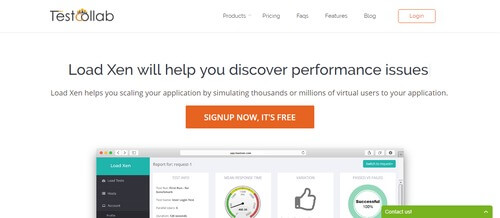
Load Xen, by Testcollab, enables you to simulate millions of requests to help you more effectively scale your applications. You can create interactions that seem just like real users to your application, randomize requests, run concurrent tests, and more with Load Xen.
Key Features:
- Simulate hundreds to millions of virtual users
- Create interactions that mimic real use
- Flexible scripting
- Real-time reporting
- Concurrent tests
Cost:
- Free: 100 VUs, max test time 2 hours
- Paid plans: $50 to $500 per month
It is important to test any software’s performance and load handling capabilities before it is released. There are many options available ranging from open source to enterprise-ready tools to perform load testing. We hope this list will help you choose the right load testing tool for your project depending on the kind of software you are building and your budget.
Improve Your Code with Retrace APM
Stackify's APM tools are used by thousands of .NET, Java, PHP, Node.js, Python, & Ruby developers all over the world.
Explore Retrace's product features to learn more.
Learn More